Tuesday, November 28, 2006


Monday, November 27, 2006
ZNet, November 27, 2006: Siege and Seizure in Korea by Cindy Sheehan
Wednesday, November 22, 2006
Sound clip from one of the US delegates during the General Strike, November 22, 2006 in Seoul
Click on "download" to listen to the clip.
Some photos from November 22, 2006: General Strike
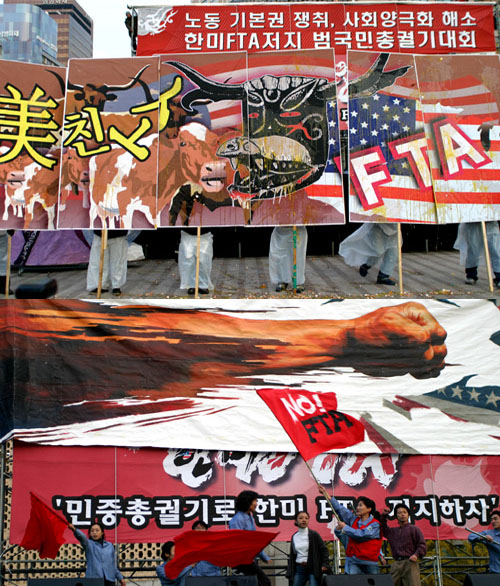
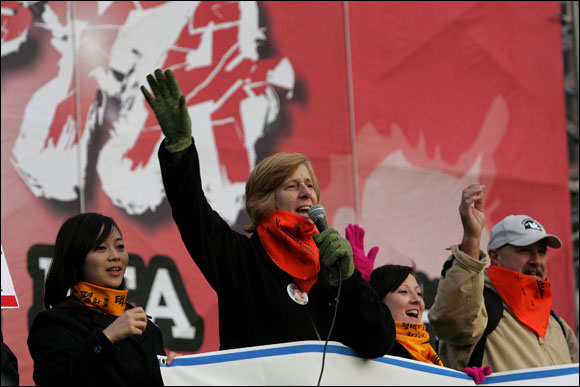

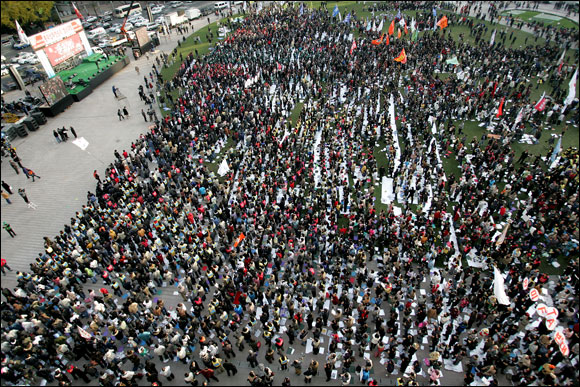
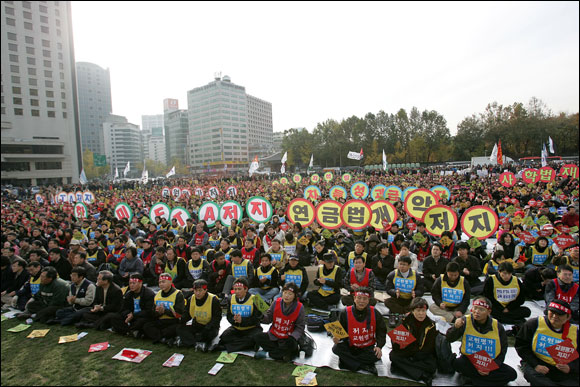

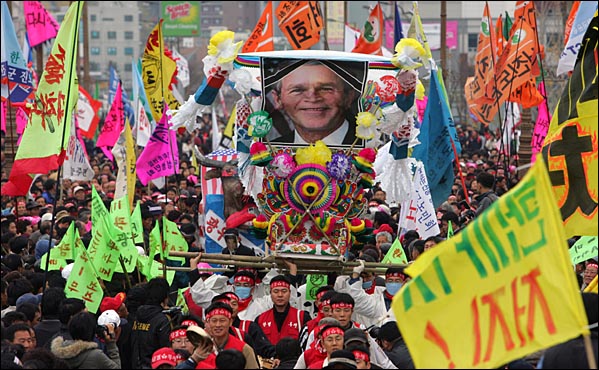
Hundreds of thousands of workers, farmers, students, activists and other progressives hit the streets on November 22, 2006 in major cities across south Korea to protest the Korea-U.S. Free Trade Agreement. The November delegation participated in the marches and rallies in Seoul.
Tuesday, November 21, 2006
US Delegation Protests Korea US Free Trade Agreement
Contact:
Christine Ahn, 011-82-10-5846- 8020
Young Choe, 347-885-9226
Sonny Le, 510-919-0790
Americans Protest U.S.-Korea Free Trade Agreement in Seoul
Seoul, Korea (Nov. 22, 2006)--An American delegation of peace, labor and social justice activists led by Cindy Sheehan is in Seoul to join the nationwide mobilization against the U.S.-Korea Free Trade Agreement currently being negotiated. The delegation is joining the Korean Confederation of Trade Unions (KCTU) who has called for a General Strike from all sectors of South Korean society to demand that the Roh government seriously address the needs of workers and peasants.
The delegation of 18 includes trade unionists, students, journalists, and peace activists from the Working Families Party; American Federation of State, County and Municipal Employees (AFSCME) Union; International Longshore and Warehouse Union; Via Campesina; Gold Star Families for Peace; Code Pink; and Veterans for Peace.
"The neoliberal policies of the Roh administration are a direct attack on the rights of South Korean workers," said Jose Schiffino of the 1.2 million-member AFSCME Union. "The struggle for these rights is the shared responsibility of all trade unionists."
The key concerns of the KCTU are to stop repression against trade union activities, to implement the ILO recommendations, to guarantee basic labor rights for irregular workers, and to repeal the current "Industrial Relations Roadmap Agreement" and replace it with laws that meet international standards.
In South Korea, approximately 60 percent of laborers are irregular workers without basic labor protections, such as the right to assemble and the right to organize. The Roh administration's "Roadmap Agreement" intends to eradicate public services, such as healthcare and education. The U.S.-Korea FTA would further strip the rights of workers and citizens to advance the interests of transnational corporations. As pre-conditions for trade negotiations, the Roh administration has already lowered emission standards on automobiles, eliminated price controls on pharmaceuticals, reduced Korean film screen quotas, and lifted the ban that was instituted on imported U.S. beef due to mad cow disease.
"Like the war in Iraq, the U.S. mid-term elections was also a referendum on free trade agreements," said Christine Ahn of the Korea Policy Institute. "Democratic candidates, especially from states that lost manufacturing jobs, won by campaigning against new free trade agreements modeled after the failed NAFTA."
"Free Trade Agreements impose more hunger, misery and exclusion," said German Bedoya, a peasant farmer from Bogota, Colombia also joining the American delegation. Bedoya, a member of Via Campesina, an international farmers' union, said, "The Colombia-U.S. FTA has impoverished our people and has stolen our national sovereignty for the benefit of enriching transnational corporations. I came to Korea to demonstrate that worker and farmer solidarity doesn't have barriers of distance or language."
Korean Americans against War and Neoliberalism (KAWAN), a coalition of U.S. based Korean organizations working to stop the passage of the FTA and the expansion of the U.S. military base in Pyongtaek, is the sponsor and organizer of the Korea trip.
Statement from Press Conference November 21, 2006

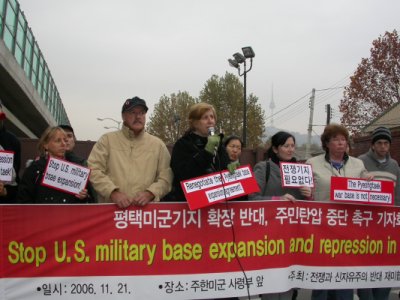
Statement of Peace and Solidarity by U.S. Delegation
We are a U.S. delegation of 18 people including students, journalists, and peace activists and members of Working Families Party, Veterans for Peace, Code Pink, Global Exchange and Gold Star Families for Peace. We came here to Korea to investigate the impact of the U.S. military base expansion on the villagers of Daechuri and Doduri.
On Monday, November 20, we traveled by bus to the village of Daechuri, a farming town adjacent to Camp Humphreys, the U.S. military base in Pyongtaek City. For over three years, the villagers have been resisting the U.S. plans to expand the base by taking over the villagers’ lands. In defending their land, their homes, and school, they have been the victims of brutal police violence and repression. Our delegation was met by over 200 police in riot gear at the checkpoint established since the forced withdrawal of villagers from their homes. Residents can only enter and exit their villages through these military checkpoints by showing their IDs. Visitors are often prohibited from entering the village because the South Korean government wants to prevent information about what is happening from spreading throughout the country and world.
The National Human Rights Commission of the Republic of Korea recently declared the military checkpoints to be illegal and in violation of the human rights of the villagers of Doduri and Daechuri. We call on the people of Korea and the international community to demand the South Korean government respect the recommendations put forth by the Commission and lift the military checkpoints.
We call on the international community to provide ongoing support to the villagers in Daechuri and Doduri through financial, moral and spiritual support. We ask allies of peace and justice to visit Pyongtaek.
Most importantly, we call for an end to the expansion of the U.S. military base Camp Humphreys. The Pyongtaek farmers have been living on these lands for three generations and deserve to stay there. The expansion of the base will in no way enhance the security of the people of the United States or South Korea. On the contrary, at a time when there needs to be a de-escalation in tensions with North Korea, expanding this base is a provocation that will only further fuel the militarization in the region.
We call on the new U.S. Congress to hold investigations into the U.S. military realignment in Korea as outlined in the 2003 Global Posture Review. This realignment, including the authorization of $11 billion for military expansion in South Korea, moves the U.S. military from a defensive to an offensive position and poses a dangerous escalation of tensions. The new Congress should halt the military expansion and reposition U.S. policy to promote peaceful relations with our Asian Pacific neighbors.
Day in Daechuri - Update from Delegation November 21st
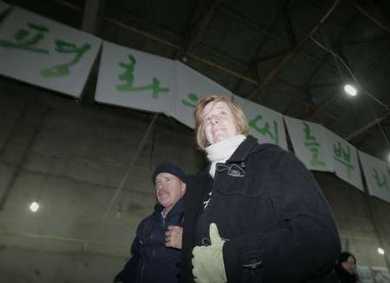

We are writing to you all from Pyongtaek prison where Kim Ji-Tae, the leader who organized the village people to organize and protest against the U.S. military expansion in Pyongtaek. Cindy Sheehan, Mario Murrillo, and Jamie Kim are in there with him right now as only 3 people were allowed to visit. As they are in there, we ran to a PC Bang (internet cafe) to send you these words of what has happened so far on our trip.
Last night, we took a 2-hour bus ride from Seoul to the village of Daechuri. For over three years now, the villagers of Daechuri and Doduri have been resisting the eviction of their homes, farmland and school for the expansion of the US military base in Pyongtaek City, Camp Humphreys. For the past year, starting on May 4, the South Korean government has sent in over 20,0000 troops to demolish homes, destroy the elementary school, and with physical violence against the elderly farmer villagers. I met a reporter from Stars and Stripes last night who told me that he was there at the crack of dawn and what he witnessed was "like medieval warfare."
Since the farmers struggle, over 1000 people have been injured and over 800 people arrested.
We arrived by bus in the evening. We were greeted by over 200 police in riot gear lining the check point. There were many press there to also greet us. It appeared that they werent going to let us through as they have been denying entry into the village for outsiders. Only residents of Daechuri are allowed access in and out of the checkpoint.
After some delay, after Cindy stepped out and had a discussion with Reverend Moon in front of the press did the police finally let us in. They probably didnt want a huge spectacle, so we were allowed access. We then crossed the second check point and made our way into the village. We got off the bus and were immediately ushered into a huge barn that had turned into the site where the candlelight vigil was held.
The farmers and elders have been holding candlelight vigils in there for over 820 days.
When I walked in to the room, I was incredibly moved to tears. It seemed my tears couldnt stop flowing. Here these people were who I saw on the internet, in videos, and in images circulated by people who had visited Pyongtaek. None of those images could capture what I felt and saw. Here these people were, the most humble people, mostly farmers and elders, sitting there peacefully. I could see the hardship they had endured but also the resolve to keep the land. It was heartbreaking to see and hear what they had endured, but incredible to witness their determination to fight for what is good right.
Monday, November 20, 2006
Press Conference in south Korea
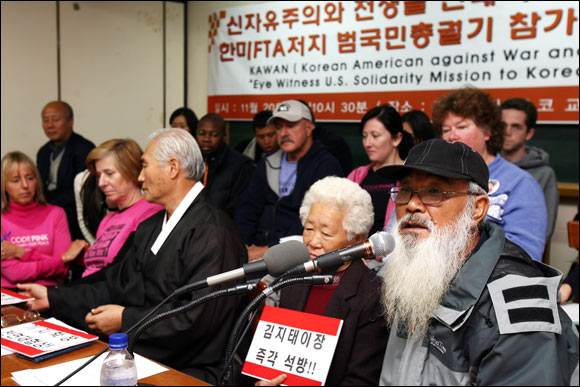
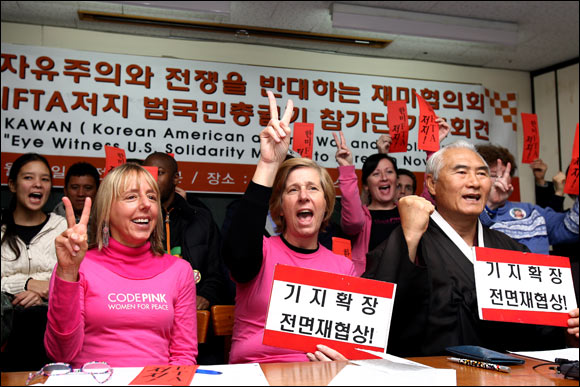
Photos of the November Delegation at a press conference in south Korea with residents of the farming village in Pyeongtaek.
U.S. DELEGATION DENIED MEETING WITH U.S. COMMANDER IN KOREA:
The delegation of 18, who is in Korea from November 20 to November 24, includes students, journalists, and peace activists and members of Working Families Party, Veterans for Peace, CodePink, Global Exchange, and Gold Star Families for Peace. They are here to protest the U.S. expansion of its military base in Pyongtaek and the U.S.-Korea Free Trade Agreement.
On Monday, November 20, the delegation traveled by bus to the village of Daechuri, a farming town adjacent to Camp Humphreys, the U.S. military base in Pyongtaek city. The villagers have been resisting relocation for over three years, withstanding brutal violence, repression and property damage by the South Korean government. The delegation was met by over 200 police in riot gear at the checkpoint established since the forced withdrawal of villagers from their homes. Only Daechuri residents with IDs are allowed in and out of the village. Due to the high profile American delegation and visible media presence, the U.S. delegation--after some delay--was allowed to pass through the heavily armed checkpoint.
The U.S. delegation joined over 100 Daechuri villagers, most elderly Korean farmers, for their 820th consecutive candlelight vigil. Since the U.S. base expansion was announced four years ago, many villagers of Daechuri and Doduri of Pyongtaek city have refused to hand over their farmlands and homes to the South Korean government. For over two years, villagers exhausted every legal channel and resisted relocation. The South Korean government sent in over 22,000 troops to erect razor wire fences around the farmland and demolished the majority of schools and homes.
According to Kim Suk Kyung, father of Kim Ji-Tae, the village leader who has been imprisoned for his vocal opposition, "No one has been compensated. If we were asked by the South Korean government to move for the cause of the Korean people, we would have done so, but not for the sake of the U.S. military."
"The U.S. military is out of control," said Cindy Sheehan. "It led to the death of my son in Iraq and it's destroying the lives of these villagers in Pyongtaek. We have to rein in our military, whose role should be to defend American people, not oppress other nations."
Medea Benjamin, founder of Code Pink, a U.S. women's peace organization, after the vigil said, "It's heartbreaking to see how the villagers have suffered because of plans to expand Camp Humphreys Base. If Americans had a chance to see how the expansion of this military base has devastated the lives of so many humble villagers, they would be outraged."
The Korea trip is organized and sponsored by Korean Americans against War and Neoliberalism, (KAWAN), a coalition of US based Korean organizations working to stop the passage of the FTA and the expansion of the U.S. military base.
Friday, November 17, 2006
November Delegation to South Korea
Cindy Sheehan and Medea Benjamin Leading Delegation to South Korea; U.S. Activists Join South Koreans to Protest U.S. Military Base Expansion and U.S.-Korea Free Trade Agreement
NEW YORK, Nov. 16 (AScribe Newswire) -- American peace activists Cindy Sheehan and Medea Benjamin are leading a delegation of U.S. peace and social justice activists to South Korea to oppose the expansion of Camp Humphrey, the US military base in Pyeongtaek, South Korea and to protest the proposed Korea-U.S. Free Trade Agreement.
The delegation of 18, who will be in Korea from November 20 to November 24, includes members of Working Families Party, Veterans for Peace, Service Employees International Union, CodePink, Global Exchange, and Gold Star Families for Peace. This will be the first trip to Korea for Sheehan, whose son Casey was killed in Iraq, and Benjamin, founder of Global Exchange and CodePink.
They will meet with elderly Korean farmers of Pyongtaek, whose farmland and homes were violently seized by the Korean military to accommodate the expansion of the U.S. military base. For over two years, Korean farmers have exhausted every legal channel and resisted relocation, holding candlelight vigils for 800 nights.
"The U.S. government spends $9 billion dollars a month on overseas military operations," said Cindy Sheehan, "We are traveling to Korea to witness first-hand how U.S. tax dollars are being spent to destroy Korean farm lands, homes, schools and lives."
According to Kisuk Yom, head of the Korean-American coalition leading the U.S. delegation, "There is no democracy for elderly villagers whose farmlands were stolen. The South Korean public, too, has been silenced, yet they are the ones who will suffer the consequences of a future military conflict."
On Nov. 22, the delegation will join the nationwide mobilization against the U.S.-Korea Free Trade Agreement. One million Koreans are expected to take to the streets in Seoul. "The proposed FTA will dramatically expand the failed model of NAFTA," says Christine Ahn, policy analyst with the Korea Policy Institute. "We will let the Korean people know what NAFTA has meant for working Americans: factories shutting down and farms falling into foreclosure."
Korean Americans against War and Neoliberalism, (KAWAN), a coalition of U.S.-based Korean organizations working to stop the passage of the FTA and the expansion of the U.S. military base, is the sponsor and organizer of the trip. "We hope this delegation will return to the U.S. to tell the American people about the true human cost of the U.S. military expansion in Korea," said Hyukkyo Suh, Executive Director of National Association of Korean Americans. "Korea is a democratic and sovereign nation, and the Korean people want -- as they deserve -- to make decisions that will affect their lives for years to come."
- - - -
CONTACTS: Young Choe, 347-885-9226
Sonny Le, 510-919-0790
Christine Ahn, 310-482-9333 or 011-82-10-5846-8020 (in Korea, Nov 20-24)
Sunday, September 10, 2006
Saturday, September 09, 2006
Civil Disobedience, Saturday morning
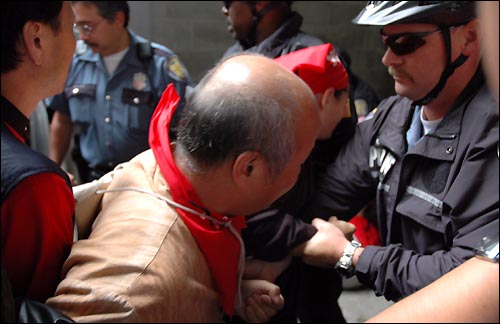
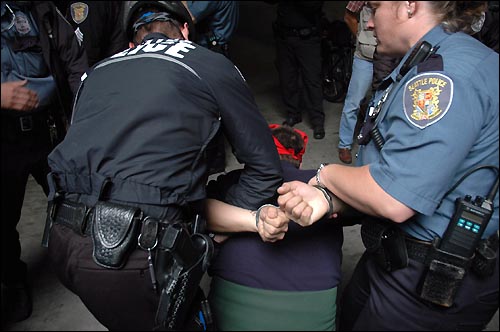
 Photos of the civil disobedience this morning in front of the Washington Convention and Trade Center where the negotiations are taking place. KoA, KAWAN and Seattle activists participated, 15 people were arrested. All the South Koreans were released without bail. Three US based activists remain in jail, but will be released tonight.
Photos from ohmynews.com
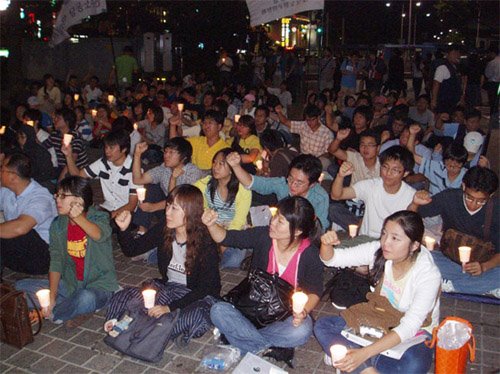
South Koreans hold a candlelight vigil while...
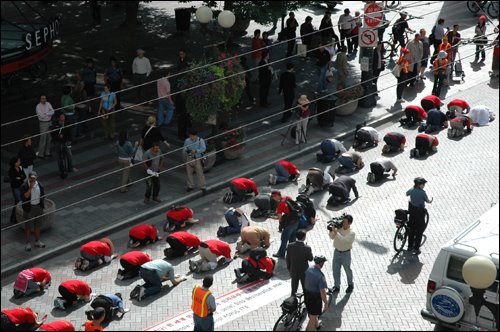
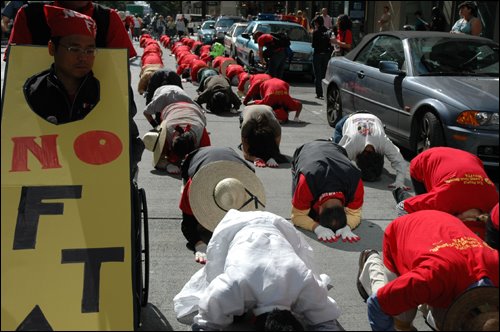
KoA, KAWAN and Seattle residents take the streets and do sam-bo-il bae - three steps and one bow.
Friday, September 08, 2006

Thursday, September 07, 2006

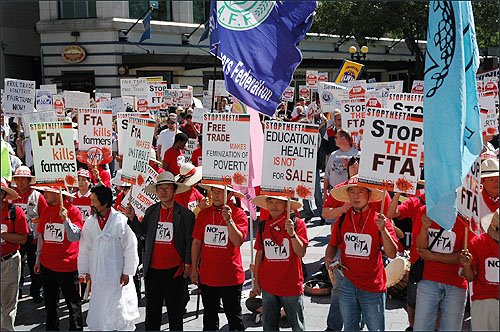
Tuesday, September 05, 2006
Click to read a Brief on the "Real Understanding of the KorUS FTA"
Monday, September 04, 2006
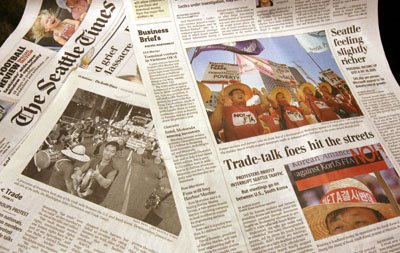
Seattle Times editorial Sunday, September 3, 2006
The editorial ends with:
Organized labor plans a protest at Westlake Center at 12:30 p.m. Wednesday. We recall the AFL-CIO's anti-WTO march of 1999, which was peaceful and law-abiding, and expect the same.
Though labor should be heard, we believe it is generally mistaken about these agreements. Freer trade begets efficiency — and efficiency benefits most of labor most of the time.
Article from Real Change News.org
A Fair Shake: South Korean activists seek “mini-WTO protest” at trade talks
Monday, August 28, 2006
The Struggle Continues!
+9/6 International Cultural Performance [by Dohee Lee, SKIM, Cuchata, and local hip-hop], Westlake Park, 6:30p
+9/6 Candlelight Vigil, Westlake Park, 8:30p
+9/8 Sam-bo Il-bae* March, Westlake Park, 1:00p
+9/9 Closing Rally & Funeral March, Federal Building, 1:00p
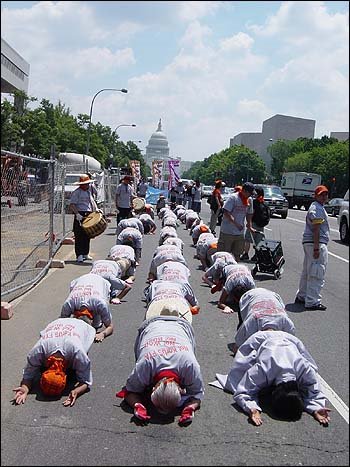
* Sam-bo Il-bae literally means "three steps, one bow." Originally born from the Buddhist tradition, it is a uniquely Korean form of protest with a long history in our resistance movements. Participants will do the entire march by taking three steps, then a full bow on our knees, touching the ground. In the process, we demonstrate and renew our deep commitment to the struggle. Sam-bo Il-bae is silent, slow, physically demanding, and extremely powerful. KoA and KAWAN invite all local allies to join us in Sam-bo Il-bae, as we renew our commitment together.
Organized by Korean Alliance Against Korea-US FTA (KoA) and Korean Americans Against War And Neoliberalism (KAWAN) stopfta@gmail.com
Monday, June 12, 2006

Sunday, June 11, 2006

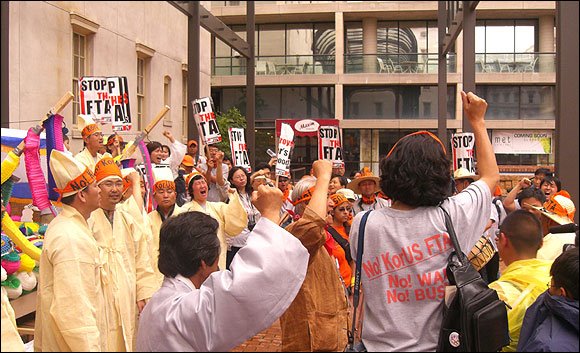
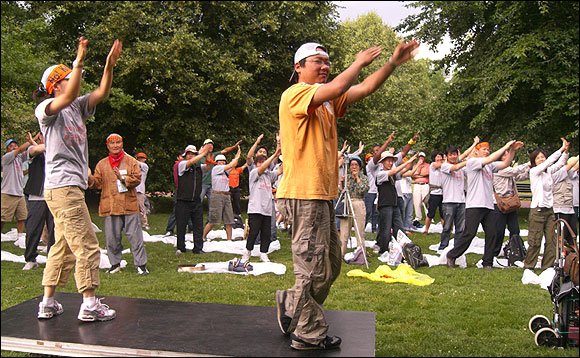
Friday, June 09, 2006
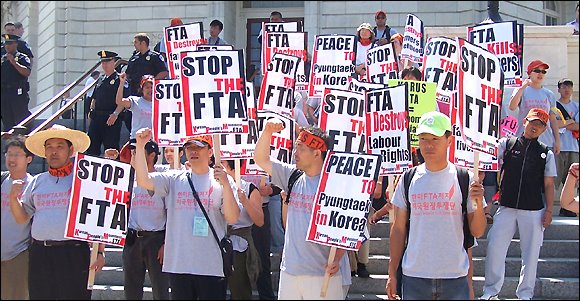
Thursday, June 08, 2006


Wednesday, June 07, 2006
Tuesday, June 06, 2006

Monday, June 05, 2006
Kucinich to Sponsor Briefing on US‑Korea Trade Agreement
The proposed US-Korea Free Trade Agreement (FTA) comes under scrutiny at a congressional press conference on June 7, 2006, at 10 a.m. at the Cannon Terrace in Washington, DC.
June 4th - Day of International Solidarity with our South Korean contingent
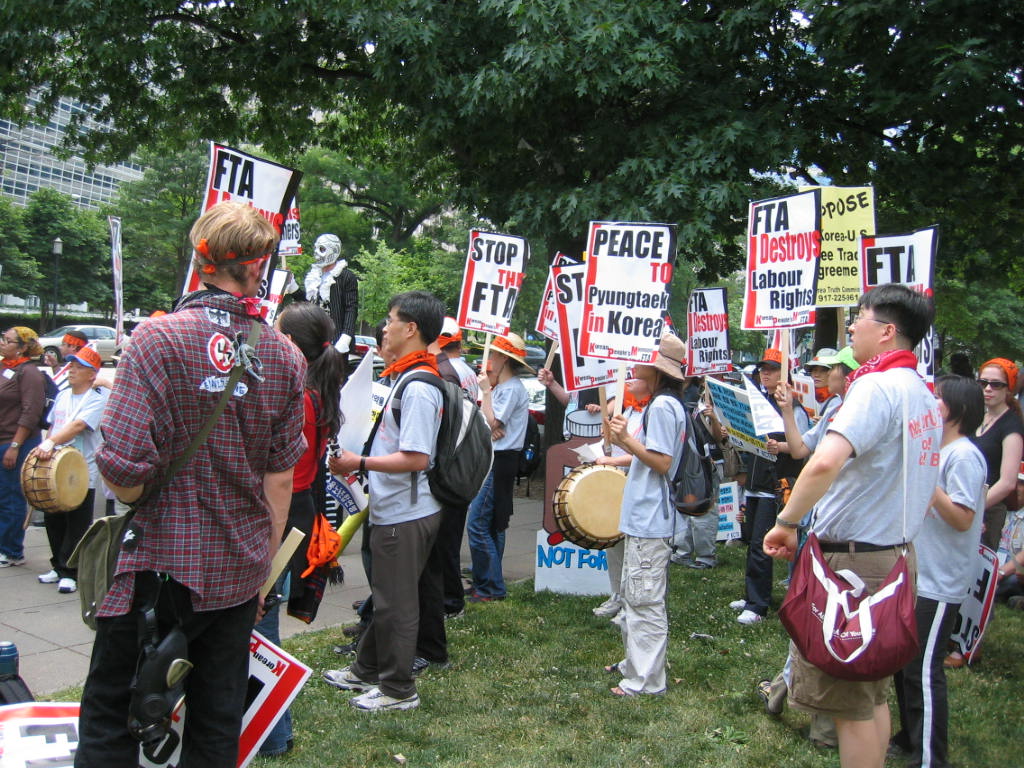


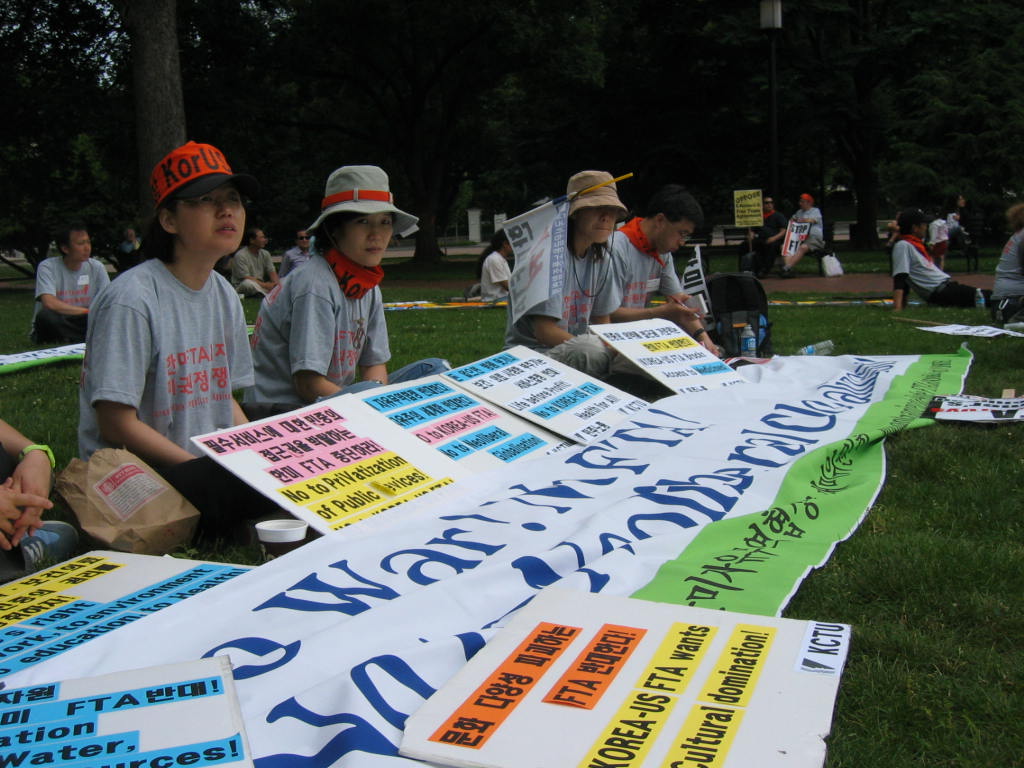
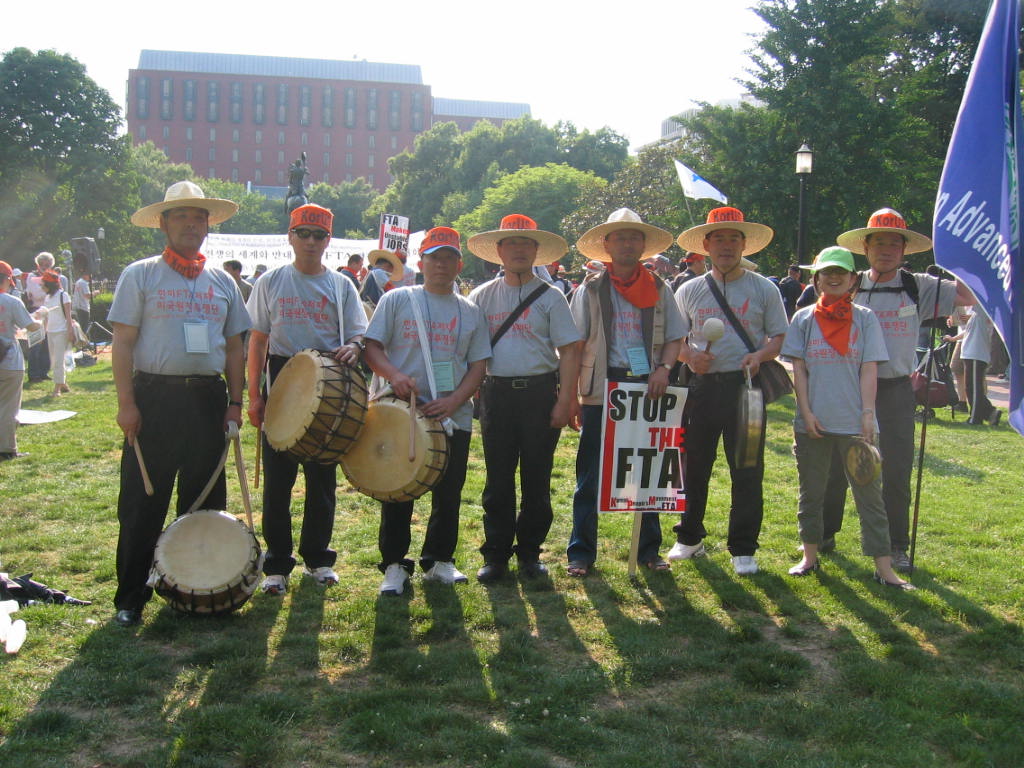
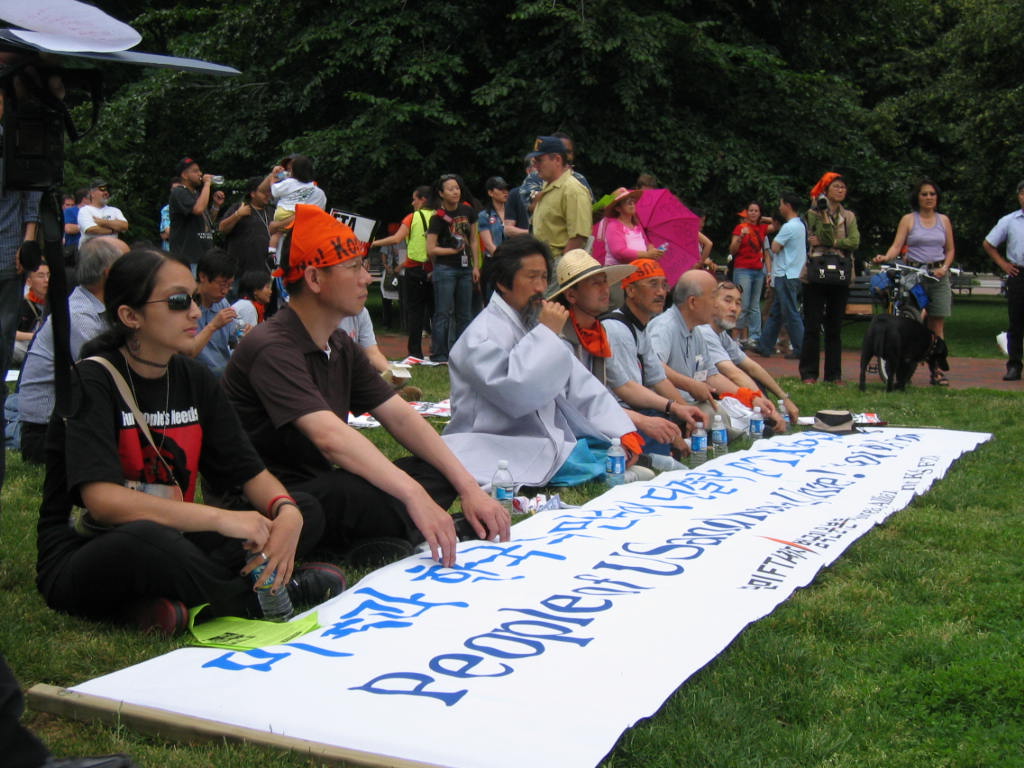
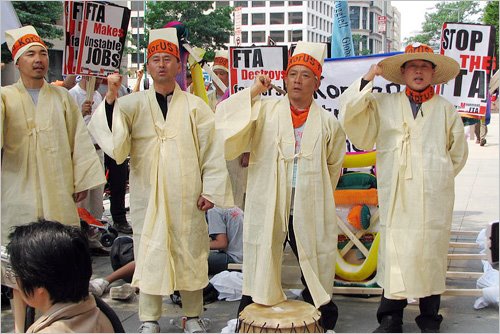
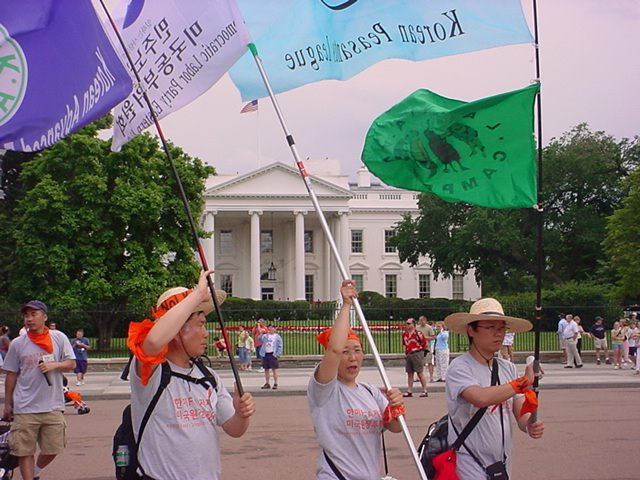
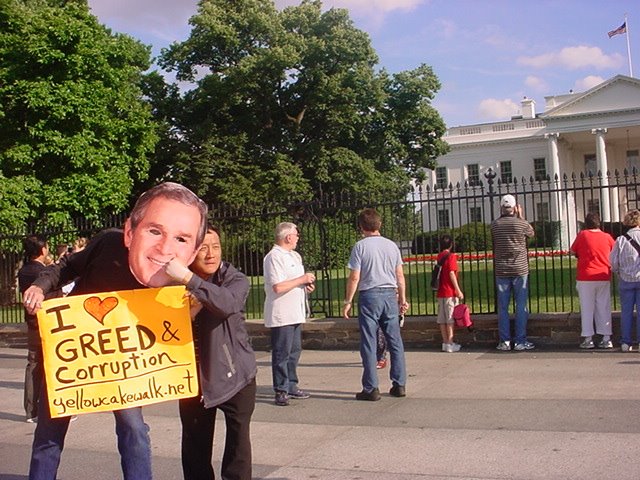
Photos from our first day of actions in Washington, DC. It started with a rally at Murrow Park and a march past the IMF and World Bank Buildings, the US Trade Representative's Office, to the White House and ended with a rally in Lafayette Park.